


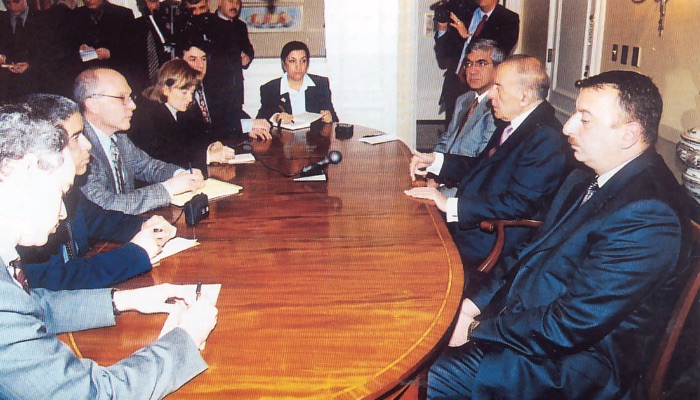
Azerbaijan’s entire oil industry history during the 19th and 20th centuries is any way associated with the attraction of foreign investments. Possessing rich resources and beneficial geographical location, Azerbaijan was always in the epicenter of struggle that certain geopolitical centers waged for the sphere of influence throughout world revolutions, wars and collapse of the USSR. There was only one person who could balance on the brink and divert this struggle toward the creative stream in favor of interests of the Azerbaijani nation as well as turn Azerbaijan into an independent and influential unit. This man was Nationwide Leader of Azerbaijan Heydar Aliyev. Today, President of Azerbaijan Ilham Aliyev keeps successfully continuing and developing this policy.
First Continental Oil Market
1889-1912
According to the official sources, the new economic policy of the czarist government of Russia showed since the mid 90s that the inflow of the foreign capital was the only way for dragging the country out of the crisis.
It was allowed to open up to 30 foreign oil enterprises in Baku from 1889 to 1892. The inflow of the foreign capital into the Baku oil industry increased by over 5.6 times from 1892 to 1902.
Rapid decline of capital import was observed from 1902 to 1908 because of the economic crisis and the beginning of the Russian-Japanese war. Foreign investors managed to gain much broader control over the Baku oil industry as the foreign capital continued strengthening positions.
Well known Paris banker Rothschild who showed up in Baku in 1883, set the task of being engaged mainly in credit related operations and oil trade. Rothschild’s initial capital grew from 1.5 mln RUB (1883) up to 6 mln RUB in 1895 and up to 10 mln RUB in 1913. Despite the fact that the French capital was dealing in trade and credit, Rothschild also possessed many oil assets: in Balakhany, Sabunchu, Romany, kerosene and oil plants in Keshla.
In conditions of small profits gained for a certain period (through 1912-1913), the Rothschild branch of the French capital passed the oil assets it had in Azerbaijan to the Anglo-Dutch corporation of H.Deterding “Royal Dutch Shell”. In return, the Rothschilds received a big package of shares for Shell (20%).
Since then the British capital has occupied a prominent place in the oil industry of Azerbaijan.
The oil fields of the British companies accounted for 11% of overall gross oil production of the country in 1911.
In 1903, there were 12 British enterprises with the capital worth 60 mln RUB operating in Baku. The British capital was spent basically on acquisition of already operating enterprises of local entrepreneurs.
It was at that time when the first equity market was created in Baku. Foreign companies enriched themselves through establishing companies, receiving money from subscribers for sold shares, and speculating at the exchange by lowering or raising share prices.
Baku – half of world oil production
Processes and phenomena, which may to some extent be observed at onshore fields today, first showed up in the oil industry of Baku at the beginning of the 20th century.
10 mln tons of oil were annually produced at the Absheron peninsula since the beginning of the century and accounted for half of the world oil production. Oil industry fell into depression by that time. The highest peak of this depression was observed through the revolution period. Though, it was in 1940 when the Republic already produced 71.5% of oil within USSR. The crisis lasted until the economic recovery after the World War II, when the first offshore oil production in 1949 promoted the development of the offshore oil industry.
Big oil deposits were explored and discovered in Kazakhstan and West Siberia with participation of Azerbaijani scientists and oilmen during 70-80s. It considerably extinguished Baku’s role as the source of oil but raised its importance as the center of oil refining and production of oil producing equipment. Azerbaijan’s share within whole CIS had declined down to 2.62% by 1993 as the development of oil fields in West Siberia and the Urals extended. However, steadily declining oil production did not lower interest of western businessmen to Azerbaijan’s natural resources. Discovery of new offshore oil fields played a certain role in it and promoted the development of offshore production also. Over 80% of recoverable oil was extracted on offshore fields. Besides, the main part of reserves of the Azeri sector Caspian shelf still remained unexplored.
1991-1993
The collapse of the Soviet Union and sovereignty gained by 15 new republics caused independent states many economic problems regarded as of paramount importance. They faced problems concerning development of priority spheres of the national economy through own efforts. A lack of this potential caused the emergence of the following clear dilemma: to push their way gradually in tough economic crisis or create favorable conditions for attracting of foreign investments and stabilization of the economic situation in the country. The first way could take too much time and cause social disruption in the whole space of the former Soviet Union.
The second way: tight combination of two rare factors was required for dealing with serious political problems and beginning of attraction of investments. They are firm political will which should have determined the priorities of the internal and external policy, as well as a clear economic program envisaging establishment of favorable conditions for attraction of investments.
It is exactly what Azerbaijan, which became an epicenter of regular struggle for sphere of influence in the Caspian region because of its geopolitical location, was missing in the early years of its independence. Another reason was the availability of big oil-gas reserves in Azerbaijan (only recoverable oil reserves totaled over 1 bln tons). Foreign investors, who already tasted the sweets of the Caspian oil boom at the beginning of the 20th century, headed to Baku as early as in 1990.
The first attempts on creating conditions for foreign companies for oil development in Absheron were made in winter 1991. A decision to conduct a tender for creating a joint venture together with Kaspmorneftegaz PU was taken in accordance with the joint decree (as of January 18, 1991) passed by the Ministry of Oil and Gas Industry of the USSR and the Council of Ministers of Azerbaijani SSR. The JV should have been engaged in exploration and development of offshore field Azeri.
As the result, the American Company won the tender in June 1991 for conduction of exploration on this field.
Later, BP/Statoil alliance, Mc.Dermott and Ramco were also attracted for participation in the project. Amoco maintained its leadership and possessed 45% of the total stake of all western companies. The spring of 1991 was marked as the time of fighting for power when the National Front, which decided to implement economic reforms and placed priority on the oil issue, came to power.
State Union Azneft continued negotiations on exploration and development of resources in the Azeri sector of the Caspian Sea. It was in June 1992 when the first information about joint oil production in Azerbaijan showed up in the American press. However, it included only discovered and operating onshore fields but not offshore development.
Another contract with the alliance of the two European companies BP/Statoil was signed on September 7th of the same year. The Alliance was granted an exclusive right to survey Azeri field and develop Shah Deniz. The share holding in the newly established joint venture was shared 50/50. Apart from this, BP/Statoil agreed to pay $30 mln for an exclusive right to conduct development operations on these fields.
Later, an agreement with Pennzoil Company was signed early in October 1992. According to the agreement, the company was provided with a right to participate in development of Gunashli field where Azerbaijani oilmen had produced oil since the beginning 1980.
The following contract for joint operations at Chirag and Shah Deniz fields was signed between BP/Statoil alliance and SOCAR in March 1993. BP had already possessed a 19% stake in Azeri field development project by that time. Thus, 4 offshore fields Azeri, Shah Deniz, Chirag and Gunashli were offered to foreign investors.
A few months later, Azerbaijan notified Pennzoil, Amoco and BP about its wish to combine all three projects into one project under single control. The companies took this news quite moderately.
BP yielded a part of its stake to the Turkish Company TPAO and it joined the parties of the future agreement during the following negotiations. Such companies as Total, LUKOIL and Iran applied to Azerbaijan with the same request. However, their proposal was rejected.
In mid of May, the companies signed the last 6th memorandum on single program of operations on all fields and the process of unification reached the final stage. The parties of the memorandum were BP/Statoil, Pennzoil/Ramco, Amoco, Unocal, TPAO, Mc.Dermott.
On June 5, the Board of Directors of SOCAR passed a declaration on combining all operations performed at Azeri, Chirag and Gunashli fields. Among foreign companies it was TPAO which did not announce about its public agreement with SOCAR. However, it joined the common statement during further stages. According to the new terms, SOCAR preserved a 70% stake whereas the rest 30% was distributed between the consortium participants.
As the result of political blunders, two neighbor countries of Azerbaijan (Russia and Iran) opposed that regime.
In April 1993, Armenia began occupation of Azerbaijani territories in Garabagh and around its borders. So Azerbaijan found itself in the grip of the heaviest economical and political crisis.
The Contract of the Century
A skillful politician and Nationwide Leader Heydar Aliyev, who was elected the President later, took the helm in such conditions. Combination of experience and knowledge, energy and cautiousness backed by the boundless trust of the people enabled the head of state to highlight key points and priorities both in the internal and external policy of the country. In its turn it turned out a key to future success. “No dominants exist any longer, there are only the interests of the country and the state that we put above everything”, Nationwide Leader of Azerbaijan Heydar Aliyev said.
President Aliyev managed to clearly determine things that were missing in the project of the oil contract.
Moreover he understood that wrong people were holding negotiations with future business partners. Taking this all into account including the political mess observed in the republic, H.Aliyev decided to postpone the signing of the contract.
As for investors they were patiently waiting for the end of the political instability in the republic and did not even think about abandoning the market. They decided to stimulate the authorities in the oil project. On June 22 1993, 8 oil companies decided to offer a $70 bln bonus to Azerbaijan in compensation of those that were scheduled to be paid after the contract has been signed.
However, despite all these tricks, the head of state remained determined and postponed the signing of the contract. Soon, Aliyev gave new explanations about the delay of signing of the contract which seemed to be already ready. “I understand that oil companies attracted to Azerbaijan pursue their own economic interests. It is quite natural. But in the meantime, we have to put the interests of our country above the interests of the companies”, President said in his interview with Chicago Tribune.
He also said that he was surprised with such strong anxiety of foreign companies when the government wished to broadly study the terms of the contract.
In his interview he made it clear that incompetent people were dealing with the contract. Therefore, much broader attention will be paid to it.
Besides, Aliyev made an explicit statement at the meeting with representatives of oil companies that was held in Baku in August 1993. “If the oil companies of big countries are interested in oil deposits of Azerbaijan, then the government agencies of these countries must also express interest to the current public-political situation of the republic”.
Further, Aliyev undertook measures for reaching a ceasefire agreement including numerous tense diplomatic negotiations with all countries involved in settlement of the Armenian-Azerbaijani conflict, suppressing domestic opposition and improving relationships with Iran. The most important thing that he did was obtaining Azerbaijan parliament’s approval of the decision about joining CIS and stopping consideration of the oil contract. All of it was done to partially meet the wish of northern neighbor.
Following the postponing of the contract signing, created was a special commission out of foreign experts which should have carried out its detailed inspection. Broad clean up was carried out in the board of directors of SOCAR and Natig Aliyev was appointed its president .
The negotiations with the foreign companies were continued a few months later.
However, some changes were made in conditions as Azerbaijan offered not three but two fields. Gunashli field was kept aside.
The contract shares were distributed in the following manner: Azerbaijan obtained 80%, 20% belonged to foreign companies shared as follows: Amoco – 24.3%, BP/Statoil – 36.7%, Pennzoil/Ramco – 17%, Unocal – 16%, Mc.Dermott – 3.5% TPAO – 2.5%. The bonus price for development of fields was increased up to $500mln. Half of it should have been paid right after ratification of the contract by the parliament of the country. It was logical to assume that the staff of the Consortium would be certainly enlarged. However, there were still many visits left to be paid and many political discussions left to be held.
As the result, new agreements were signed one by one. A total of 22 contracts were signed with companies representing 30 countries of the world. Two oil pipelines for export of early oil from ACG contract area were commissioned one by one within 2 years: Baku-Novorossiysk (5 mln tons per year) and Baku-Supsa (5 mln tons per year at initial stage). Negotiations about main export oil pipeline (or the transportation corridor Baku-Tbilisi-Ceyhan named after Heydar Aliyev as it was called at that period) were launched with foreign companies in 1998. A decision about construction of the Baku-Tbilisi-Erzurum gas pipeline was taken later.
Today Azerbaijan is successfully diversifying its economy, developing its own production and exporting finished products. “There is still much to be done”, President of Azerbaijan Ilham Aliyev says in his interview with the Russian newspaper. “I want Azerbaijan to become a prosperous country over the period of my presidency and I want to abandon policy in a principally different country which moved toward public progress throughout all these years”.
Speaking at the world economic forum hosted in Baku, President Ilham Aliyev said: “Our economic development began from the energy sector which still remains attractive for foreign investments. However, diversification is our main objective for now. Therefore, we should stand in front of the world business not as the country that possesses an important geographical location and natural resources but as the country which stays committed to reforms, changes and diversification”.