


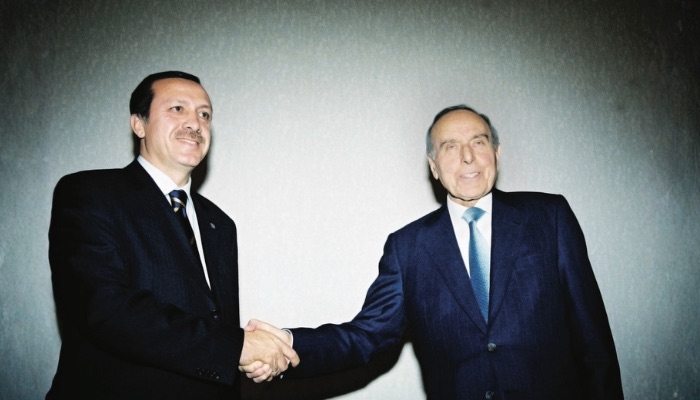
The world history features many examples of distinguished people nominated by the nation in hard critical times of their history. With their unique gift of foresight, a high sense of responsibility and love to their people, they headed their nations and honourably led them out of the most severe and hard trials. Many examples can be provided, but there are only few ones who stood out with their outstanding merits throughout the history.
In Turkey it was Mustafa Kemal Ataturk (1881-1938) who was a Turkish reformer, a politician and a statesman, the first President of the Republic of Turkey and the founder of the modern Turkish state.
In France it was Charles de Gaulle who was a French general, a statesman, the founder and the first President of the Fifth Republic (1959-1969) and even today France is living according to the principles of the Constitution approved that time.
The Prime Minister of emergency situations of Great Britain (as he was often designated in the narrow political circles) Sir Winston Leonard Spencer-Churchill (1874-1965) was a British statesman and a political figure, twice the Prime Minister of Great Britain during 1940-1945 and 1951-1955, the winner of the Nobel Prize in Literature (1953) and the greatest Briton in the history according to the poll of the BBC conducted in 2002.
In Azerbaijan it was Nationwide Leader Heydar Aliyev who twice (1969-1982, 1993-2003) headed Azerbaijan at first as a part of the former USSR (1969), then in the period of gaining independence (1993). Heydar Aliyev was able to lead Azerbaijan (in 1993 Azerbaijan was in the hardest economic, political and social crisis, defending itself from the fierce military aggression of neighbouring Armenia that had occupied 20% of the primordial Azerbaijani lands and made 1 million Azerbaijani citizens refugees) to a new historical stage of modern development never before occurred in the history of the Azerbaijan nation. It was a way of independence, democracy, national consciousness, independent foreign and economic policy and creation of a multi-religious civil society.
1969-1982 years
In the seventies of the last century, thanks to Heydar Aliyev, Azerbaijan was living through its Renaissance. That time some statesmen and political figures of the USSR visited Baku and each visit resulted in solving some issue important for Azerbaijan. If to refer to the archives of those times, they will obviously show a certain consistency. After each visit of USSR-wide politician or statesman one or another new industry started developing or construction of new plants and factories was launched in Azerbaijan.
Those years products manufactured in the republic adequately reflected its economy. It is difficult to list all the achievements of those years. The Air Conditioners Manufacturing Plant, Deep-Water Jackets Factory, Electronic Computers Plant, Ulduz Plant, Ozone Plant, Nord Production Association, Sumgayit Chemical Plant, a unique EP-300 facility, jewelry, footwear and macaroni factory, the Davachi poultry farm and others were constructed at that period. Oil refineries, Mingachevir HPP, ‘Moscow’ Hotel, Gulistan Palace and Republic Palace underwent the full reconstruction.
In the 70-80s more than 4 billion rubles were contributed to reclamation and irrigation facilities. These funds helped to create gross assets worth 3.5 billion rubles, complex reclamation works were performed on 270,000 hectares of new irrigated lands and on 550,000 hectares. Agstafachay, Terterchay and Khanbulagchay water reservoirs were constructed.
Those years a powerful space device engineering & researches plant was created in Azerbaijan and became a basis for carrying out the unique space experiment “Gunesh”.
Only in Ganja Billur plant, the machine-building plant, the earthenware factory, the second turn of the carpet weaving factory, the bakery plant, etc were constructed. And cultural-educational institutions were established across the territory of Azerbaijan.
Following a subtle and sometimes very risky policy, using strong and weak points of the political situation of those times, Heydar Aliyev promoted attracting of more and more new investments into Azerbaijan. In the difficult and subtle political game in the Politburo and around it, with the enormous tension of forces, Heydar Aliyev continued increasing investments into the republic. Those years, the fields of Western Siberia were discovered and thus forced Azerbaijan out of the leading positions in the oil industry of the USSR. The oil producing industry of Azerbaijan was not able to bring good benefits to its people since it was a part of the regulated Soviet economy. At the inner-union prices of those times, neither cotton nor grapes could bring good income.
Heydar Aliyev’s efforts promoted Investment flows into Azerbaijan.
In 1973 I was invited to work as a correspondent for the Central Television and All-Union Radio on Azerbaijan, the TV journalist Mais Mammadov recollects. The key task was to collect and prepare materials for the main news program of the country, Vremya. Azerbaijan, which had been far from the leading positions among the USSR republics those years, seemed to awake from a long sleep. The entire republic turned into a huge construction site. Residential buildings were built, new enterprises created, crops of cotton, grain, vegetables were growing. And all those successes were indissolubly connected with the new strong-minded First Secretary of the Central Committee of the Communist Party of Azerbaijan Heydar Aliyev who was the first in the Soviet Union to start introducing new management principles, bringing fundamental changes to the former ones.
We can take, for example, agriculture. Heydar Aliyev regularly visited the regions of Azerbaijan, accompanied not only by journalists, but also by literary and art figures. «Let them see with their own eyes how wheat is cultivated», the First Secretary joked. It is noteworthy to say that Heydar Aliyev was great on agriculture like a highly qualified agronomist. Thanks to this, when speaking with workers of villages, he showed brilliant understanding of their problems. The situation was the same when he, for example, visited oil industry workers, mechanic engineers, chemists.
I remember well, M. Mammadov says, that those years Baku hosted the Days of Culture of the Russian Federation. The best writers and poets, musicians and actors, composers and artists visited us. And the head of the Party Organization of Azerbaijan met them all. Cultural professionals and art figures were very surprised after meeting him. «For the first time we meet a party leader with so brilliant knowledge of literature and art», they told journalists. They and we too could hardly know that Heydar Aliyev every day and every hour worked on himself, spending no more than 4-5 hours per day on sleeping and rest …
Azerbaijan was changing more and more. From the beginning of the 70s of the last century, every year the republic became a winner of the All-Union Socialist Competition. A brilliant push to further development of agriculture was given by the famous decree on development of winegrowing in Azerbaijan that Heydar Aliyev facilitated in Moscow.
The Deputy Minister of Agriculture of the USSR told Aliyev that he had warned the Georgians that Azerbaijan would soon leave them behind in grape growing. They laughed, saying that the Kura River would rather flow back sooner Azerbaijan leaves Georgia behind. And recently, he continued, I visited Georgia again and in my speech said: “Well, the Kura is flowing as before, but Azerbaijan left you far behind”. This time there was not laughter in the hall. The growing harvesting capacity of grapes, cotton, vegetables, tea certainly improved the welfare of villagers and consequently promoted a construction boom in the regions of the republic. Committed efforts, professionalism, the brilliant ability to think on his feet regarding everything new and the independent way of thinking predetermined Heydar Aliyev’s further destiny.
It is now well understood that if in the 70s Azerbaijan had failed to create the industrial potential, the country would have faced inextricable difficulties after USSR’s collapse. Western oil companies started development fields in the Azerbaijani sector of the Caspian Sea in 1994 mainly due to the stability in the republic, available high-class specialists and the expensive equipment for offshore oil and gas operations, which had been purchased in the 70s.
In December 1982, Heydar Aliyev was elected a member of the Politburo of the Central Committee of the Communist Party of the Soviet Union, and was appointed the first deputy chairman of the USSR Cabinet of Ministers and became one of the leaders of the USSR.
The General Secretary of CPSU Yuri Andropov reassigned him to work in Moscow and charged to supervise 17 Union ministries. There Heydar Aliyev also won people’s love and respect. Everyone who used to work together with him note his main features such as competence in discussing different issues, independent decision-making without shifting the responsibility to other shoulders, aspiration to bypass numerous bureaucratic obstacles of those times and leaving the maximum freedom of action to responsible executives.
Being the First Deputy Chairman of the USSR Cabinet and supervising important industries, Heydar Aliyev with his high creative potential found numerous like-minded people among the large organizers of production. In the hard times for Azerbaijan they supported the republic as they could when Heydar Aliyev came to power.
Speaking about the Soviet epoch of his activity in one of his interviews the Azerbaijan leader said: “I was not just a pawn in Gorbachev’s Politburo when in 1985 we began the so-called “perestroika” (restructuring)... It might sound immodestly, but just find time for reading Aliyev’s report delivered on April 22 on the occasion of the 115th anniversary of Lenin’s birth. In 10 hours Mikhail Gorbachev delivered the report on “perestroika” at the plenary session of the Central Committee of CPSU. Comparing them you will see that the views I stated are even more radical than those of the General Secretary’s. And not in word but indeed I settled down to the course of democracy, without any maneuvering, and the rest of my life I will give to the service for my nation». After the Chernobyl disaster Heydar Aliyev was one of the few leaders of the USSR who advocated for provision of the full information about the disaster to foreign journalists and his nation.
The entire infrastructure of Azerbaijan’s industry was organised in line with the principle «to extract more Azerbaijani oil in a faster way». Only Heydar Aliyev was able to change this system, which had not allowed receiving a final product and consequently the republic provided only semi-finished products for export. Many branches of industry not related to oil and gas production and petrochemistry appeared during Heydar Aliyev’s office. He obtained quotas from Moscow and every year sent young people to study in the leading higher education institutions of the USSR. Thereby he created a layer of highly qualified specialists so strongly needed in Azerbaijan. Summing up the above-mentioned, it can be unambiguously said that Heydar Aliyev, who held senior positions in Azerbaijan, then in Moscow and who in 1993 headed his nation, showed that he was the world famous personality.
1993-2003
On June 20, 1990 Heydar Aliyev returned to Baku and already the other day, on June 22, he departed to Nakhchivan. In Baku there was a real threat to his life from the side of official structures. From September 3, 1991 till June 9, 1993 he was in power in Nakhchivan, being in the political and economic blockade created by both partycrats and newly minted democrats. In such severe conditions he applied all efforts to keep the situation under control, working in a cold cabinet lightened with the kerosene lantern.
The situation in Nakhchivan was awful then. It was living through, probably, the most difficult period of its history. At that time the leadership of Azerbaijan held almost enemy position towards Nakhchivan. Just remember the leader of Azerbaijan said that time: «Nakhchivan is like appendix for me, if necessary I will cut it off». Under such circumstances Heydar Aliyev took the lead in Nakhchivan.
He started laborious, formidable everyday work on actual rescuing Nakhchivan from hunger and cold, rescuing from death. Turkey started supplying products, electricity, fuel, and President Souleymane Demirel himself visited Nakhchivan. The President of Iran Hashemi Rafsanjani also did not stand aloof and the flow of vital freights did not stop from this country. Heat, electricity returned to houses of Nakhchivan people, products appeared in stores. The threat of death receded. Though fights continued in Garabagh, the ceasefire mode was established in Nakhchivan.
In winter 1990 the Supreme Soviet of Nakhchivan submitted the petition to the Supreme Soviet of Azerbaijan requesting to exclude the words «Soviet» and «socialist» from the name of the Nakhchivan Autonomous Republic, rename the Supreme Soviet into a Supreme Majlis and adopt a three-colored national flag as a heritage of the Azerbaijan Democratic Republic, which had fallen as a result of the aggression of Bolsheviks in April 1920.
The activity of the Communist Party was suspended there. The population refused to take part in the Referendum on preserving the Soviet Union, though the authorities in Baku carried out this event across Azerbaijan. The political assessment was announced for the «black January» tragedy that took place in 1990. December 31 was announced the World Azerbaijanis Solidarity Day.
A brick by brick creation of the own border guard, national army and statehood was started that time along with implementation of the agrarian reform. But all this caused rage and envy of official Baku instead of understanding and approval. In October 1992 the Baku authorities undertook a shameful military expedition against Nakhchivan and Heydar Aliyev. But it failed with a crash.
Meanwhile the situation in Azerbaijan was not improving. In the summer of 1993 the country stood on the verge of collapse.
In 1993 the leaders of the People’s Front of Azerbaijan, who completely failed the construction of independent Azerbaijan, urgently called Heydar Aliyev to save the country. The situation was very daunting then. That time the Armenians intended to reach Ganja through Terter and Barda and take control over the entire western territories of the republic. In the south of the country Aliakram Gumbatov was trying to create the Talysh-Mugan republic. In the north of Azerbaijan sadvalists raised the head. And the country was on the verge of a civil war. The situation was complicated by the full stagnation of economy, quickly progressing inflation and demoralized army. It becomes clear that the destiny of Azerbaijan literally hung by a thread.
Special meeting of Milli Majlis elected Heydar Aliyev the speaker on June 15, 1993. On June 24, 1993 the parliament authorized him to fulfill the duties of the President of Azerbaijan. Finally, he was elected President of Azerbaijan by the nation-wide voting.
Heydar Aliyev made an unyielding statement during his inauguration: “One of the main tasks that independent Republic of Azerbaijan faces is organization of statehood building. Our way is clear and we have repeatedly declared about it, it is the way of democracy. A rule-of-law state based on democracy principles must be established in independent Azerbaijan. Using its historical traditions, relying on world experience and universal human values, Azerbaijan must go along the way leading to the democratic state. It is the way we have chosen and today I promise that I will stay committed to it”.
A hard and painstaking work began for full restoration of the statehood and stability in Azerbaijan. So much efforts and energy the great man directed for saving the country. Journalists who chanced to cover foreign visits of Heydar Aliyev saw the way the leaders of England, France, China, Belgium and many other countries met Heydar Aliyev at first and how respectfully they saw him off.
During his foreign visits, Nationwide Leader of Azerbaijan worked practically round the clock. While people accompanying him were tapped out, he used every minute for meeting ministers, officials of firms and banks convincing them not to be afraid of investing money into the development of Azerbaijan’s economy.
The witnesses remember Heydar Aliyev’s meeting in Germany with representatives of the chemical concern which used to erect capacities in Sumgayit. “You are a phenomenon, Mr. President. I have never seen such a thing before”, the head of the chemical concern said after Heydar Aliyev, described full production cycle and called the details of things necessary for reconstruction.
Now among Heydar Aliyev’s main achievements we can especially note:
- Heydar Aliyev was the only leader who did not yield even an inch of Azerbaijani land.
- Owing to Heydar Aliyev and his sizable reputation both in CIS and foreign countries Nakhchivan managed to overcome the blockade imposed by the communist regime and the People`s Front of Azerbaijan on the autonomous republic.
- Surrounded by numerous enemies of independent Azerbaijan, it took titanic efforts for Heydar Aliyev to prevent the threshold civil war and stop the Armenian aggression.
- A combat-capable army which stopped the advancing of the Armenian aggressor, made it sign an armistice and start peaceful negotiations, was created within a short period of time. It may be said without exaggeration that an international conspiracy set against Azerbaijan was defeated.
- After reaching an armistice, signing contracts, taking its niche in CIS and conveying the whole truth about Armenian aggression against Azerbaijan to the most important states of the world, Heydar Aliyev laid a foundation of new relationships with the CIS states.
- Amidst hard conditions when Heydar Aliyev faced the strongest opposition of external and internal forces, he managed to persuade the western companies of the successful political future of Azerbaijan and continue negotiations about development of offshore fields in the Caspian Sea.
- The first contract (later they numbered 22 in general) that is hard to overestimate in the future fate of Azerbaijan was signed. Along with the economic factor, it created a new geopolitical situation in the Caspian-Black Sea region and far beyond it.
- Rebels inspired by neighbor countries were suppressed with the help of people and power ministries. Who knows what terrible consequences the Azerbaijani nation would face if the rebel initiators gained victory.
- A leader heading the country is one of the main parameters in the system of international relations. Heydar Aliyev’s unique personality is known well enough in the international community. Meetings and negotiations that Heydar Aliyev held with executives of leading western companies helped Azerbaijan to present itself in a worthy manner at international political arenas. It in its turn helped to receive credits and international aid that the republic was deprived of in previous years. Several Azerbaijanis were elected deputies to the Georgian parliament owing to the purposeful and dynamic policy of Heydar Aliyev whereas there had been no deputy representing Azerbaijan there before. The attitude of the authorities of this republic toward Azerbaijan was improved considerably. Aliyev-Shevardnadze became a strong political force.
- A decision on transportation of early oil along the two directions -Russian (north route) and Georgian (west route) - created a situation of dynamic balance in the region. Azerbaijan’s long-term interests based on economic factors were put forward when choosing the main route for oil export.
- An international symposium dedicated to the restoration of the Great Silk Road was initiated by the President of Azerbaijan in Baku with participation of Presidents of interested countries.
- Solemn commissioning of Baku-Supsa oil pipeline which became a reality regardless of the pressure of neighbor countries took place on April 17, 1998. Not only the Azerbaijani but also Kazakh oil may be exported along the pipeline. The commissioning of the Baku-Supsa route means the restoration of the Great Silk Road.
- Implementation of the project of strategic oil pipeline for export of big volumes of Caspian oil along Baku-Tbilisi-Ceyhan route, and the project of Baku-Tbilisi-Erzurum gas pipeline started. The operating Baku-Novorossiysk and Baku-Supsa as well as the planned Trans-Caspian gas pipeline practically changed the whole geopolitical situation in the region and turned Azerbaijan into a more important player in the world energy, economic and political arena.
According to the data of IMF, the dynamics of investment attracted to Azerbaijan looks as follows :
* (the forecast of the government of Azerbaijan)
Meanwhile, assets of State Oil Fund of Azerbaijan reached $34 bln 325.7 mln as of April 1, 2013.
No other oil producing republic of the former Soviet Union but Azerbaijan managed to sign so many contracts with the western companies. And neither of them may boast such an impressive investment dynamics. Foreseeing changes in the world energy market and world economy, Heydar Aliyev has for the first time in the world worked out Azerbaijan’s energy security model for many decades to come.
“Azerbaijan’s location at the junction of Europe and Asia obliges it to establish good relationships with the European, Asian as well as all other countries of the world”, Heydar Aliyev says. So the country establishes strategic friendly relationships with important world geopolitical centers which have been traditionally competing with one another.
Reflecting for the first time in the world over its security and independence that are inseparably associated with the energy security Azerbaijan demonstrated the world the reality of alternative thinking in this extremely traditionalist and stereotyped sphere of the global economy. The leading world economies, the USA for instance have announced it a main vector for handling the financial-economic crisis observed over the past years. After delivery of Azeri oil to the world markets by means of the three oil-export routes, Azerbaijan is holding successful negotiations with its partners for gas export to the global markets. A new strategic project TANAP (Trans-Anatolian gas pipeline) emerges. “Today, gas sector plays an important role in ensuring energy security and energy independence of the world countries”, President Ilham Aliyev says. Azerbaijan already has 7 export pipelines enabling it to respond flexibly to the change of the situation at the world market.
Over the past years Azerbaijan managed to turn from the recipient country into a donor supporting other states. According to Ilham Aliyev, despite the crisis raging in whole Europe the economical situation in Azerbaijan remains stable that is also fixed in international ratings. The country’s authority is growing in the international arena. It is exemplified in Azerbaijan’s election as a non-permanent member of the UN Security Council.
It was Nationwide Leader Heydar Aliyev’s decisiveness that helped to lay the basis of this strategy in 90s, President of Azerbaijan Ilham Aliyev emphasized.
Nursultan Nazarbayev, President of the Republic of Kazakhstan:
Heydar Aliyev was my close friend and a politician whom I esteemed highly. We all know that Heydar Aliyev did much both for CIS states and his nation. The future generations will be able to truly assess his merits to the nation. Heydar Aliyev was trying hard to promote the wellbeing of his nation right to the last minute.
Recep Tayyip Erdogan, Prime Minister of the Republic of Turkey:
Heydar Aliyev was a recognized and favorite leader not only in Azerbaijan but also in the whole Turkic world. He is the author of the phrase “One nation, two states”, the phrase that perfectly expresses the Turkish-Azerbaijani friendship. We must do our best for the idea, expressed in this wise saying, to live in future. Stating it, we must aspire toward protection and strengthening of our brotherhood and unity of the whole Turkic world. Dear Heydar Aliyev, whose death shook us all, worked hard in the sake of development of the region. This genius person did much for the implementation of both the Baku-Tbilisi-Ceyhan oil pipeline and Baku-Tbilisi-Erzurum gas pipeline projects. The Turkish-Azerbaijani relationship obtained such a firm foundation that no other force is capable to break it.
Vladimir Putin, President of the Russian Federation:
I did not simply respect Heydar Aliyev. I treated him with love. He was a big state leader and political rock. Heydar Aliyevich (Aliyev) was a big political figure of the former USSR and indeed made broad contribution to the development of bilateral relations between Russia and Azerbaijan over the past years.
I would like to note once again that Azerbaijan is one of few countries of the Former Soviet Union where no Russian schools were closed, and the number of periodical publications released in the Russian language increased compared to that of the soviet period. And all of this happened despite the difficulties that we have faced in the Caucasus so far.
Heydar Aliyev was a well known figure not only in Azerbaijan but also within the former Soviet Union. He was an amazing person, smart, skilful leader, and a real politician. Heydar Aliyev is known far beyond Azerbaijan. I must frankly say that Azerbaijan was fortunate in being governed by a politician known both in Europe and worldwide. On the one hand he was an internationalist: on the other hand he was a big patriot. Heydar Aliyev was a friend of Russia.