


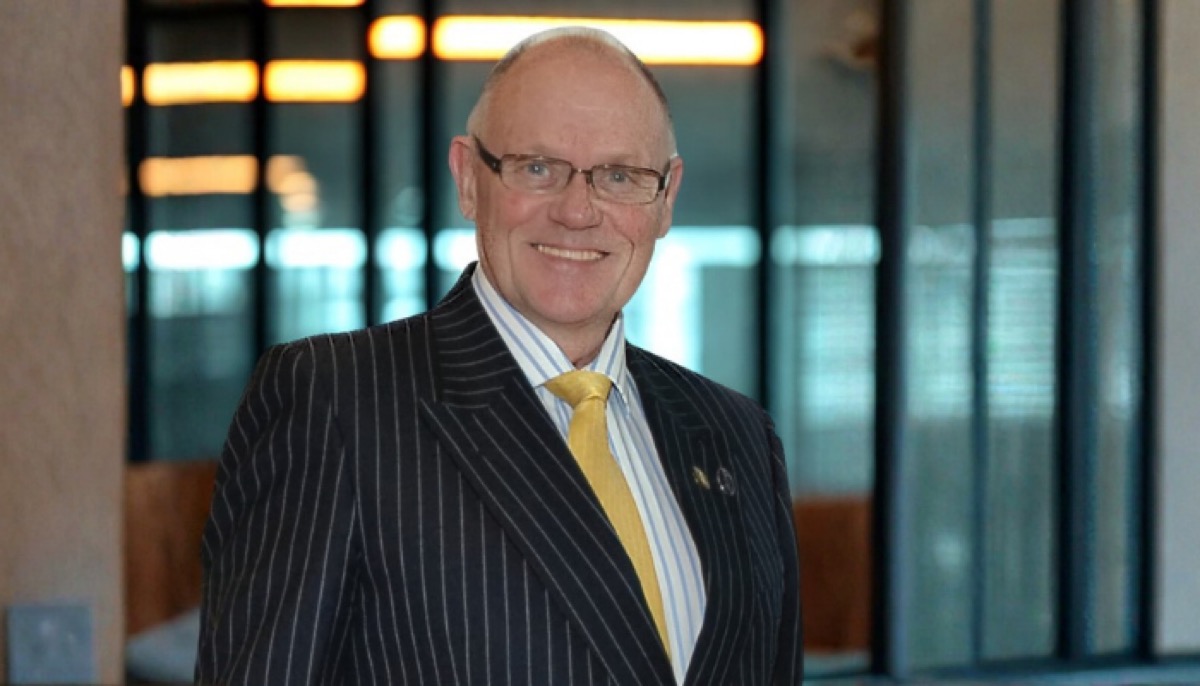
Caspian Energy (CE): Could you please speak about company’s activity, about prerequisites of its creation and the way it entered Azerbaijan’s market?
Christopher Mott, General Manager, Fugro Survey LTD (Caspian): Fugro, via a legacy company, entered Azerbaijan in the mid-1990’s as the search for oil and gas in Azerbaijan progressed further offshore and into deeper waters. Success in deeper water and at greater distances from shore requires the highest standards of offshore surveying so that offshore facilities can be properly designed and precisely located. The particular geological hazards present on and within the seabed of the Caspian Sea have to be accurately charted and assessed for risk. Offshore facilities must then be engineered to avoid or tolerate these risks. Fugro brought these skills to Azerbaijan and continues to develop them.
CE: How do you evaluate the results of company’s activity following the outcomes of the past year? What results has the company managed to achieve?
Christopher Mott: Last year was very busy for Fugro.
We spent time providing resources for the installation of some new oil pipelines offshore Azerbaijan. We provided precise positioning using the USA’s GPS and Russian Glonass satellites. This makes sure that all ships and barges are accurately positioned to within 10 centimeters on the surface of the sea. We provided accurate sub-sea positioning using acoustic methods to ensure that the pipelines and other structures being placed on the seabed are exactly where they are designed to be. We use precise positioning together with records of previous surveys to ensure that the current installation operations do not interfere with infrastructure that is already installed on the seabed. We have also been using Remotely Operated Vehicles to observe and inspect new sea-bed infrastructure and check on the location and condition of existing infrastructure.
CE: Which of success gained by the company would you like to note in particular?
Christopher Mott: I would like to highlight two successes, one technical and one organisational. On the technical side, we have been working with one of our clients to improve the way in which the external condition and position of existing pipelines is monitored. The new technique involved creating a digital model of the pipeline and the seabed upon which the pipeline lies, by bouncing many many sound beams off the area. The results were very good and have increased the accuracy of our information about the pipelines and their relationship with the seabed. We are continuing to work on refining this technique and continue to look for other ways to improve knowledge of the condition of pipelines laid on the sea-bed. This information is important to ensure that disruption to the flow of oil and gas is not interrupted and to be safe against leaks into the environment.
On the organisational side, we have been talking to recent graduates from Azerbaijan’s Oil Academy and to graduates from other tertiary education establishments with a view to offering trainee positions to suitably qualified and motivated individuals. We are already arranging training courses for them to be held in Azerbaijan in the near future. We are very pleased to be in a position to invest in the future of Azerbaijan’s oil & gas industry by tapping into its own talent base.
CE: Which latest technologies is the company ready to provide in the Caspian region?
Christopher Mott: As mentioned above, we are using leading edge satellite technologies to provide precise positioning both at the surface of the sea and at the seabed. We are also using state-of-the-art acoustic technologies to improve the monitoring of existing pipelines lying on the seabed. Laser technologies will be employed later this year in an onshore project to accurately map the surface of the land for large scale developments. Tens of square kilometres per day can be surveyed using LiDAR (or Laser Imaging Detection And Ranging). An airplane flies over the survey area along precisely defined parallel tracks. The airplane is equipped with a LiDAR system. This system bounces a laser beam off the surface of the earth many times per second. The time-of-flight of each laser beam is captured and very complex data processing algorithms are used to turn this time-of-flight data into a very accurate digital terrain model of the survey area. This technique delivers results in days that would otherwise take months, using conventional terrestrial techniques, giving planners more time for design and developers a greater chance of keeping to the critical path
CE: What are the main lines of development in accordance with a strategic plan of development of the company for 2013?
Christopher Mott: LiDAR is one technology that we are bringing in to Azerbaijan in 2013. Another technology is AUV (Autonomous Unmanned Vehicle). An AUV is preprogrammed to survey the seabed. It is launched and it carries out its task without being physically controlled from the surface. The benefits of this are in the quality of the survey data that is acquired. First of all the AUV is programmed to operate in the ideal position with the respect to the seabed to get the highest quality data. Secondly, the device is very quiet acoustically, therefore there is nothing extraneous to compromise the clarity of the records. Thirdly, the passage of the device through the water is smooth and at a constant speed so that the scale of the record is perfect. These systems are perfectly suited to operations in deeper water where conventional, surface towed systems cannot provide data of adequate clarity or positional accuracy.
CE: Does the company plan to expand its business in Caspian countries?
Christopher Mott: We are always monitoring the Caspian Sea region for opportunities to work. As and when these opportunities present themselves we will evaluate whether we can offer valued added services and remain competitive under the specific circumstances.
CE: What importance does the company attach to safety and social liability issues?
Christopher Mott: We place great importance on not only safety, but health and the environment. We operate in accordance with our Integrated Management System (IMS) which incorporates Quality, Health, Safety and Environmental issues. We are accredited against the international standards of:
- ISO 9001:2008 - Quality
- OHAS 18001:2007 – Occupational Health
and Safety
- ISO 14001:2004 – Environmental
Late last year, we underwent a major audit of the system which awarded us renewal of our accreditations for years to come.
We have a dedicated QHSE department that ensures that we operate in accordance with out IMS and enables us to integrate our IMS with those of our clients.
At Fugro, we recognise that having an IMS is only part of the solution. Our QHSE department, supported by senior management, ensures that the spirit of the system is adhered to as well as the letter. This means that our concerns for our employees and their concerns for themselves and their work colleagues is real and contributes to the safety and the well-being of us all. We want our people to go home safely at the end of their working shift and go to work on the next one, confident that they are as safe as possible.