


Georgia is sick and tired of revolutions, military shocks and trade wars. Therefore, the constructive and consistent foreign policy chosen last October by the Prime Minister of Georgia Bidzina Ivanishvili has quickly yielded first fruits - Georgia managed to establish a dialogue with her main partners: Brussels, Baku and even Moscow.
During the first months Bidzina Ivanishvili accurately highlighted key focuses in foreign policy and specified the main directions of development of the Georgia’s economy.
Tbilisi-Brussels
“Georgia is a key member of the Eastern Partnership Programme and the purpose of the EU is to bring the country closer to the European Union”, José Manuel Barroso said during his meeting with the Head of the Georgian Government. According to the President of the European Commission, several chapters have been already agreed during the Association Agreement negotiations. “We are achieving real progress in the Deep and Comprehensive Free Trade Area negotiations; and we hope that the pace of trade reforms in the country will allow us to complete these negotiations prior to the 2013 Eastern Partnership Summit to be held in Vilnius, Lithuania. We are also moving forward in our visa liberalization dialogue, it is another key feature of our relations”, Barroso emphasized.
“We have analyzed the dynamics and defined goals for sooner developing of our relations,” Bidzina Ivanishvili replied. He promised that Georgia would do everything to manage and fulfill goals and instructions set by the Eastern Partnership action plan before the 2013 summit. The Prime Minister said Georgia’s main goal now is signing an association agreement prior to the summit.
At the World Economic Forum in Davos Bidzina Ivanishvili said that Georgia’s main priority still was the European integration. In Davos the Prime Minister of Georgia was also the first leader of Georgia with whom his Russian colleague Dmitry Medvedev managed to have a talk after the events of August, 2008. It is in fact a good sign which designates a probable positive step in future relations between the two countries.
“If we speak about new priorities of our foreign policy, this is to patch up the relations with Russia, as you know Russia is our main big neighbor and we have very serious problems with this state. We do believe that a direct dialogue with Russia will help to resolve all the issues. Probably, not immediately, but when this dialogue restarts, we hope to solve all of them in the future”, the Foreign Minister of Georgia Maya Pandzhikidze said in the interview to the Lithuanian media.
Tbilisi-Baku
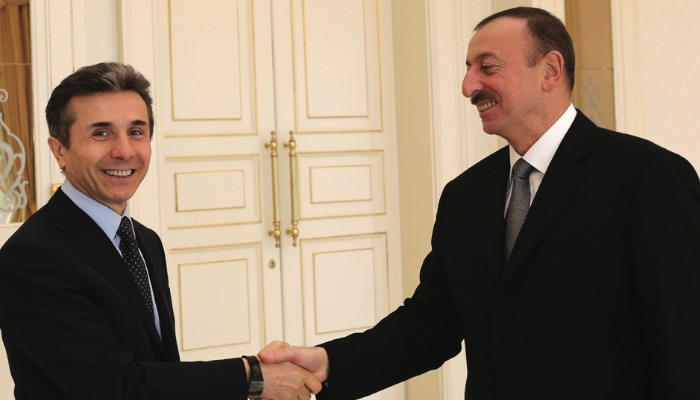
The Prime Minister of Georgia has called his first pre-New Year visit to Baku very interesting and positive. With great pleasure I would like to emphasize once more that we have very good relations with Azerbaijan. Moreover, we are strategic partners. I would also like to assure the Georgian people that we would continue working in this direction with our neighbor. We will be not only friendly countries, but also important strategic partners. We should not undertake any decisions on issues connecting our countries without a mutual consent and certainly will not do it”, Ivanishvili emphasized.
“The principle used for gas supplies from Azerbaijan to our country surprised me very much. As for the contract, in winter and in summer gas is supplied on different terms. Naturally, in the summer we consume less gas than stipulated in the contract and pay less, while in winter we consume more gas and nobody asks what the contract provides. We pay for what we consume. I have been in business for many years and never met such a case. In this I see special attitude to our country”, the Prime Minister of Georgia said.
He especially emphasized the work of the Azerbaijani business in Georgia. “These are honest and correct relations. They are based on emphatically respect attitude to the Georgian people, our traditions and customs. These relations are worth a lot”, the Prime Minister of Georgia Bidzina Ivanishvili resumed.
Indeed, Georgia has been the old strategic partner of Azerbaijan in the implementation of the energy security strategy since 1994 (signing the Contract of the Century, Azeri-Chyrag-Deep-Water Gunashli PSA, in Baku under the leadership of the National Leader of Azerbaijan Heydar Aliyev). Therefore, Azerbaijan like nobody else is interested in prosperity and stability of Georgia.
July 26-29, 1993 (Ankara) - The joint transportation commission established by Turkey and Georgia began negotiations on the project of new Baku-Tbilisi-Kars railway line.
March 8, 1996 (Tbilisi) - The intergovernmental agreement on transportation of Azerbaijani oil through the territory of Georgia via the Baku-Supsa route was signed.
October 29, 1998 (Ankara) - President Heydar Aliyev of Azerbaijan, President Eduard Shevarnadze of Georgia, President Nursultan Nazarbayev of Kazakhstan, President Islam Karimov of Uzbekistan and President Suleyman Demirel of Turkey signed the Ankara Declaration regulating transportation of Caspian energy resources, in particular Azerbaijani oil to international markets via the Baku-Tbilisi-Ceyhan route.
November 18, 1999 (Istanbul) - The Istanbul Declaration on achieving of agreement by the workgroups of Azerbaijan, Georgia and Turkey on Baku-Tbilisi-Ceyhan (BTC) Main Export Pipeline Project was signed.
September 29, 2001 (Baku) - Azerbaijani President H.Aliyev and Georgian President E.Shevardnadze signed the Intergovernmental Agreements (IA) and other corresponding agreements between the Republic of Azerbaijan and the Republic of Georgia on transit, transportation and sale of natural gas from the Shah Deniz field.
July 20-21, 2002 (Istanbul) - A protocol envisaging implementation of the Baku-Tbilisi-Kars project and performing of the preparatory work for the mentioned project was signed at the session of the Transport Ministers of Turkey and Georgia.
June 14, 2004 (Tbilisi) - President of the Republic of Azerbaijan Ilham Aliyev and President of Georgia Mikhail Saakashvili confirmed their support to the project on construction of the railway line from Georgia to Turkey and Azerbaijan’s readiness for participation in this project.
August 2-5, 2004 (Ankara) - During the meeting dedicated to development of transport relations Azerbaijan-Turkey and negotiations on Baku-Tbilisi-Kars project, the parties reached an agreement on preparation of the project for conduction and coordination of engineering survey operations.
November 14, 2004 (Baku) - Azerbaijani, Turkish and Georgian parties signed a joint statement on importance and regional significance of the Baku-Tbilisi-Kars project during the conference of Transport Ministers held upon an initiative of the European Commission.
December 28, 2004 - An agreement for creation of the joint working group on Baku-Tbilisi-Kars project was signed.
October 16, 2004 (Agstafa) - Official ceremony of ’Golden Welding’ took place on the Azerbaijani-Georgian border with participation of Azerbaijan’s President Ilham Aliyev and Georgia’s President Mikhail Saakashvili. Pipe sections connecting Azerbaijani and Georgian parts of the Baku-Tbilisi-Ceyhan (BTC) export oil pipeline were symbolically welded to each other.
May 25, 2005 (Baku) - A ceremony of inauguration (celebration of first oil consignment loading) at the Azerbaijani section of BTC export oil pipeline was held at main pump station of the Sangachal terminal by the Presidents of Azerbaijan, Georgia, Turkey and Kazakhstan.
May 25, 2005 (Baku) - An important document was signed at the opening ceremony of the main export pipeline Baku-Tbilisi-Ceyhan. President of the Republic of Azerbaijan Ilham Aliyev, President of Georgia Mikhail Saakashvili and President of the Turkish Republic Ahmet Nejded Sezer signed a Declaration on the Baku-Tbilisi-Kars railway project between Azerbaijan, Georgia and Turkey.
September 19-20, 2005 (Ankara) - Baku-Tbilisi-Kars project agreement worked out by the Azerbaijani side was presented to the Georgian and Turkish sides during the meeting held by the working groups of railway departments of Turkey, Georgia and Azerbaijan. An agreement on creation of the coordination council of the project was reached as well.
January 12, 2007 (Tbilisi) - The final version of the Baku-Tbilisi-Kars railway project was discussed at the session of Transport Ministers of states-participants. The documents concerning the framework agreement and intergovernmental financial-credit allocation were initialed after discussion of all items.
January 16, 2007 (Tbilisi) - Georgia started receiving gas from Azerbaijan’s field Shah Deniz.
May 11-12, 2007 (Krakow) - The first session of the Energy summit took place. Six countries (Azerbaijan, Poland, Ukraine, Georgia, Lithuania, and Kazakhstan) created a new energy corridor. Final communique declared about the establishment of the block of states united by common strategy in implementing their energy policy.
February 7, 2007 (Tbilisi) - A three-side meeting of President of the Republic of Azerbaijan Ilham Aliyev, President of Georgia Mikhail Saakashvili and Prime Minister of the Turkish Republic Recep Tayyip Erdogan was held. An agreement on the commencement of construction of the Baku-Tbilisi-Kars railway was signed following the results of the meeting.
May 22-23, 2008 (Kiev) - The third session of the Energy summit was held. Azerbaijan, Ukraine, Georgia, Latvia, Lithuania, Poland, Estonia, EU, USA, high-ranking representatives from over than 30 countries discussed the course of implementation of Eurasian oil transportation corridor on basis of Odessa-Brodi oil pipeline, as well as the issues concerning the Feasibility Study of Eurasian oil transportation corridor project, concept on creation of Baltic-Black Sea-Caspian energy transit community.
November 14, 2008 (Baku) - The fourth session of the Energy summit was held. President of Azerbaijan Ilham Aliyev, Turkey’s President Abdullah Gul, Lithuania’s President Valdas Adamkus, Ukraine’s President Victor Yushchenko, Georgia’s President Mikhail Saakashvili, Poland’s President Lech Kaczynski, Vice-President of Bulgaria Angel Marin, Hungary’s Prime Minister Ferenc Gyurcsany, Estonia’s Prime Minister Andrus Ansip, US Energy Minister Samuel Bodman, Andris Piebalgs, European Union’s Commissar for Energy issues, and representatives of 21 countries took part in the session. As a result of the forum, the Declaration of Baku Energy Summit was accepted.
February 14, 2009 (Bucharest) - Azerbaijan, Georgia, Romania and Hungary signed a protocol within the frameworks of realization of AGRI project. The document underlines the necessity to assist the project participating companies in attracting financing for preparing of FS.
April 13, 2010 (Bucharest) - Azerbaijan, Romania and Georgia signed memorandum on cooperation in the energy sphere. According to the project, Azerbaijani gas liquefied in Georgia will be supplied to Romania. There it is to be transformed into natural gas again. According to the preliminary estimates, the project costs $6.5 bln.
May 12, 2010 (Tbilisi) - A protocol on the establishment of the joint Georgian-Azerbaijani-Romanian company in Bucharest for working on the feasibility study of the AGRI project was signed.
September 14, 2010 (Baku) - Presidents of Azerbaijan, Georgia and Romania signed Baku declaration on improvement of Azerbaijan-Georgia-Romania Interconnector (AGRI) project. On the same day SOCAR, Romgaz and GOGC signed Memorandum of Understanding on establishment of a joint company by the three countries and on implementation of AGRI project.
February 14, 2011 (Bucharest) - Azerbaijan, Georgia, Romania and Hungary signed a protocol within the frameworks of AGRI project implementation. The document underlined the necessity to support participating companies of the project in attracting necessary financial support to work out the FS.
January 1, 2013 (Baku) - State Oil Fund of Azerbaijan has allocated $431.3 mln (as of January 1, 2013) since it joined in the Baku-Tbilisi-Kars railway project. SOFAZ has been financing this project in accordance with Azerbaijan President’s order “On performance of Baku-Tbilisi-Kars project related work” dated February 21, 2007.