


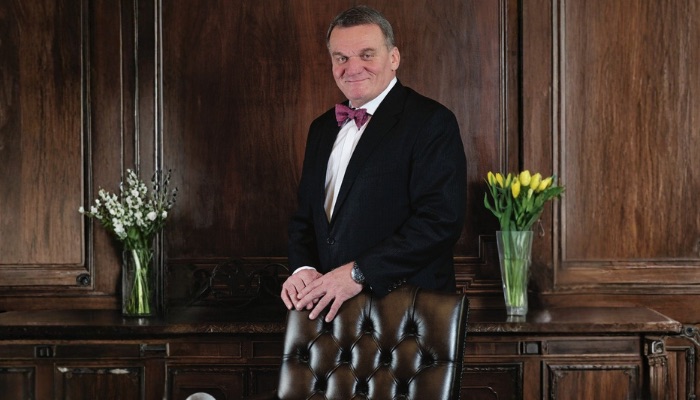
Caspian Energy (CE): The Czech Republic is one of the industrialized countries in Central and Eastern Europe. In what ways has the Euro-zone crisis affected the economy of Prague?
Bohuslav Svoboda, Mayor of Prague: The economic recession affects the Czech Republic thus logically it has effects on the economics of its capital. In parallel with this, the change in the law on distribution of tax revenue between the State and municipalities in the Czech Republic transferring part of the funds in favour of smaller municipalities at the expense of several large cities, including Prague, has started to take effect. Due to these influences we will cut the Prague spending for the next year by about five to six percent, and even though we have not increased the debt load of the city for several years, we have to utilize the loan of the European Investment Bank in this and next year to complete the investments, mainly into transport, that are already in progress. Due to the high rating of Prague these financial resources are relatively cheap nevertheless it is still a long-term burden from the city perspective.
CE: For centuries, Prague has been attracting people from all over the world by its beauty, size and mystery. How well is the tourism infrastructure developed in the city?
Bohuslav Svoboda: We have inherited the historical genius loci of Prague of course but after 1989 it was necessary to build a modern tourist infrastructure. Prague has it today, the capacity of accommodation and service is very good. There remains the problem of not fully developed transport network. The municipal public transport system is one of the best in Europe but we also continue to invest heavily in it. The construction of the next section of Metro is ongoing. The completion of the automotive circuits which will allow diverting a great number of private cars out of town remains a problem. These construction projects are carried out by Prague and the state together and they are in progress. A partial problem of connecting Prague with Europe by sufficiently high quality railway connection remains as well but this issue is being solved by the Czech state through building rail corridors.
CE: It is well known that the Prague metro is the seventh largest underground railway in Europe in terms of its annual passenger flow. What kind of projects in the construction of new lines are now in progress in Prague, and what sources you will draw funding for these projects from?
Bohuslav Svoboda: The extension of metro line A from today’s terminal station in Dejvice, which is in the wider city centre, to the western part of the city, to Motol, is in progress. The line D to the southern edge of the city is being prepared. These are the currently running or planned investments. Funding of the construction of route A is covered, partly from the city’s own resources, partly by using the credit granted by the EIB, and a substantial part of the investment should be covered from the European Structural Funds. The line D is not yet covered financially, the city will have to address it in the coming years.
CE: Some grandiose changes have started taking place in the public transport system in Prague. Could you please tell us about the most important changes already made?
Bohuslav Svoboda: “Grandiose changes” probably is not an exact representation of what is currently underway in Prague. Rather, it might be better to say that after decades when the public transport developed basically by simply establishing or complementing tram and bus lines in relation to the development of Prague and its needs, now we change public transport systemically. In practice, this means that the changes do not apply to the metro, but a so called metropolitan network of tram and bus lines is being introduced. It is a system of backbone lines passing through the city. Of course, the vast majority of existing services remain, only the overlapping services, i.e. sections where tram and bus run in parallel, are being cancelled. There, the passengers will now transfer to trams. It is a system used in a number of European cities because the metropolitan public transport network is more efficient and provides some economic savings.
CE: What do you think of the overall situation in the construction market in Prague at the moment?
Bohuslav Svoboda: The economic recession has reflected on it, quite logically, and some investors put off their projects and wait for further economic development. However, Prague has managed to keep the key public investments running and well paced, which secondarily also means that the construction companies and other suppliers do not have to reduce their capacity significantly and they are ready to respond to the positive development of the economy at any time. From another point of view, it helps to keep the unemployment rate in Prague at a very low level.
CE: How would you evaluate the results in the area of zoning planning for a current year?
Bohuslav Svoboda: Prague was preparing a new zoning plan but we and our new coalition partner in the city leadership have discontinued this work and started to work on a zoning plan based on a different concept. Instead of detailed planning of even relatively small areas, larger areas will be specifically defined in terms of their basic functions, which will turn the zoning plan into a clearer, more efficient and flexible tool. Of course, the currently existing zoning plan is in effect but we are in a kind of transition period that will last for at least two more years.
CE: The Czech Republic has a relatively stable and successful economy. What are the current economic indicators of the development of Prague?
Bohuslav Svoboda: Unfortunately, the indicators of regional gross domestic product are published by the statistical office with a considerable lapse of time, the last number available to us is for the year 2010, when the GDP of the city of Prague increased by 3.4 % year-on-year, reaching the level of 776,968 CZK per 1 inhabitant. A very important indicator, which is updated quite often though, is the unemployment rate, which reached 2.8 % in the 2nd quarter of 2012 in Prague and declined by 1.8 % vs 2011. An interesting indicator is the average wage, which reached 31,716 CZK in Prague for the first half of 2012 and increased by 1.4 % vs 2011. Finally, the development of the number of guests in collective accommodation establishments is an important indicator for the metropolis and its tourism. In the first half of 2012 this number reached 2,431,812 persons, i.e. an increase of 7% vs 2011.
CE: What technology innovations that are now being used in the construction industry?
Bohuslav Svoboda: This is not a question for public administration because even though the technological development is closely related to the city, the city is the investor only in the case of public works and most development is carried out by private companies. We are more interested in the urban and financial aspects, and quality technology is a matter of the construction companies and their offer to us as a customer, from this perspective.
CE: Is there a possibility of cooperation with Azerbaijan in ICT area?
Bohuslav Svoboda: Prague, of course, welcomes any cooperation very much but with regard to development and production, it is more a question for the relevant ministry and specialist offices. As a city we support technological development and companies working in the field but otherwise we are merely recipients of the outputs of these technologies. We will be happy to share our experience with the application of these technologies in public administration anytime.
CE: Which areas do you think are promising for cooperation between Prague and the cities in the areas of the Caspian and Black Sea?
Bohuslav Svoboda: Prague normally cooperates with a number of cities, primarily in the cultural field, the issues of urban development, public administration organization, and a number of sub-problems according to the interests of both parties as well. It is always to be of mutual benefit which is determined by the interest of the specific cities based on their specifics. Generally speaking, Prague will and can learn anywhere and it is prepared to discuss cooperation and partnership with anyone.
Thank you for the interview